
 2 hours ago
10
2 hours ago
10
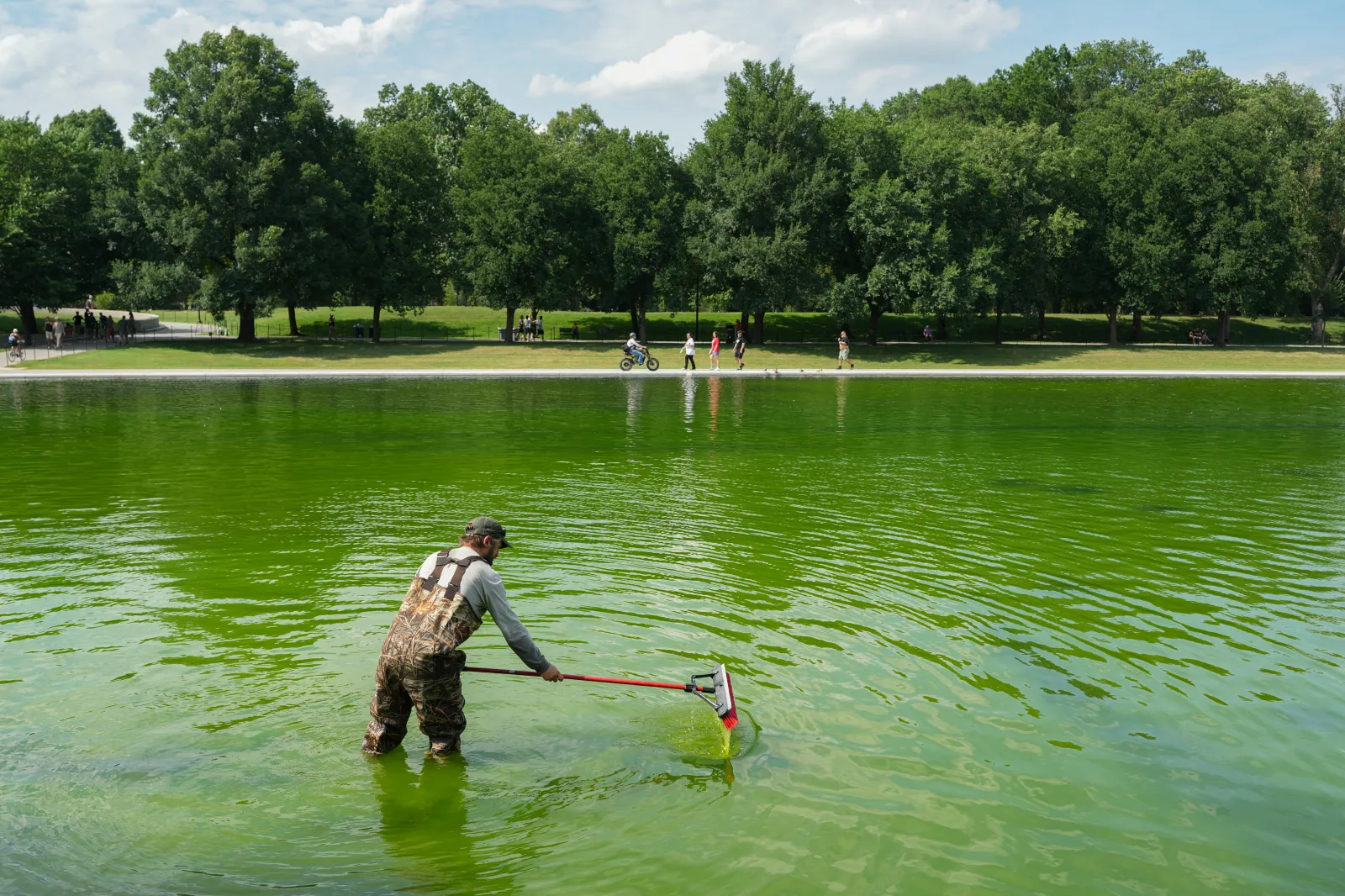
The Lincoln Memorial Reflecting Pool has turned an unexpected shade of green just days after reopening, with footage showing workers pouring what appears to be hydrogen peroxide into the water to tackle a fast-spreading algal bloom.
The high-profile cleanup effort comes after a multimillion-dollar renovation aimed at giving the century-old pool a deeper “American flag blue” finish—raising fresh questions about what went wrong and whether the chemical treatment now being used is safe.
Officials have confirmed hydrogen peroxide is being deployed alongside filtration systems to try to restore the pool’s clarity.
Why the Lincoln Memorial Reflecting Pool Turned Green
Algae blooms in the reflecting pool are not new. The shallow, slow-moving body of water—fed in part by the nearby Tidal Basin—has long created ideal conditions for growth.
But the speed of this latest bloom has drawn attention.
The pool was drained, repainted and refilled within a compressed timeframe, potentially leaving residual algae in pipes and systems while introducing freshly warmed water during early summer heat.
“Given that a single cell can reproduce into millions within days, this is not viable to fully prevent,” Christopher Lowe, a marine biologist at Swansea University, told Newsweek, noting that algae can re-enter water systems through multiple routes—including being carried in by birds.
For a bloom to take hold, Lowe said, the conditions are relatively simple: “You need to have a sufficient supply of light and nutrients.” While sunlight cannot be controlled in an outdoor site like the National Mall, nutrient levels can.
Why Hydrogen Peroxide Is Being Used
Hydrogen peroxide is commonly used in water treatment as an oxidizing agent that can break down algae and other organic contaminants.
Officials described it as a “milder treatment than chlorine,” often used in natural swimming pools and similar environments where wildlife is present.
The chemical is being used alongside so-called “nanobubble” ozone systems designed to kill algae and pathogens throughout the water column.
But in a pool holding roughly 6.5 million gallons of water, treating the bloom at scale presents a significant logistical challenge.
"At this stage we are moving away from natural cycles and into pool maintenance, which is essentially a way of trying to control those cycles. The use of hydrogen peroxide is very common in this situation,” Lowe said. "The hydrogen peroxide will have the advantage of both killing the algae and making it colorless (bleaching), which will help the appearance."
Problems With Using Hydrogen Peroxide
Workers pouring hydrogen peroxide into the Lincoln Memorial Reflecting Pool to tackle a sudden algal bloom have sparked fresh questions—not just about what’s being used, but whether the approach will work at all.
The treatment is part of a broader effort to restore the pool’s appearance after it turned green days following a multimillion-dollar renovation. Officials say hydrogen peroxide is being used as a “milder” alternative to chlorine, alongside filtration systems designed to kill algae and contaminants.

1. The Sheer Scale Problem
The Lincoln Memorial Reflecting Pool holds millions of gallons of water—around 6.5 million by most estimates.
That scale has led to skepticism over how effective manual dosing can be. Videos show workers manually pouring containers of 12 percent hydrogen peroxide into the pool from the edge, but treating a body of water that size would typically require far larger quantities to significantly reduce algae levels.
Experts say dosing in open systems must be carefully calibrated to concentration rather than volume—something that becomes increasingly complex at scale.
2. Cost vs. a Short-Term Fix
Hydrogen peroxide is widely used as an algicide, but it is not a permanent solution.
“The hydrogen peroxide only works in the very short term,” Lowe said.
Because it breaks down rapidly into oxygen and water, it does not remain in the system long enough to prevent future growth.
That raises questions about cost-effectiveness. Treating a pool of this size at sufficient concentrations—and repeating that process as algae returns—could potentially run into significant expense, particularly when compared with longer-term fixes focused on nutrient control and circulation.

3. A Design Trade-Off: Still Water vs. Circulation
At the heart of the issue is a long-standing tension in the reflecting pool’s design.
Algae thrives in warm, slow-moving water—conditions that are effectively required for the mirror-like surface the landmark is known for.
While increased circulation or aeration can help reduce algal growth, it can also disrupt reflections.
Experts say managing the pool therefore becomes a balancing act between aesthetics and water quality—one that has challenged multiple renovation efforts over decades.
The recent overhaul, which included resurfacing and changes to the basin, may also have altered how heat and nutrients behave in the system, potentially accelerating bloom conditions.
4. Wildlife and the Wider Environment
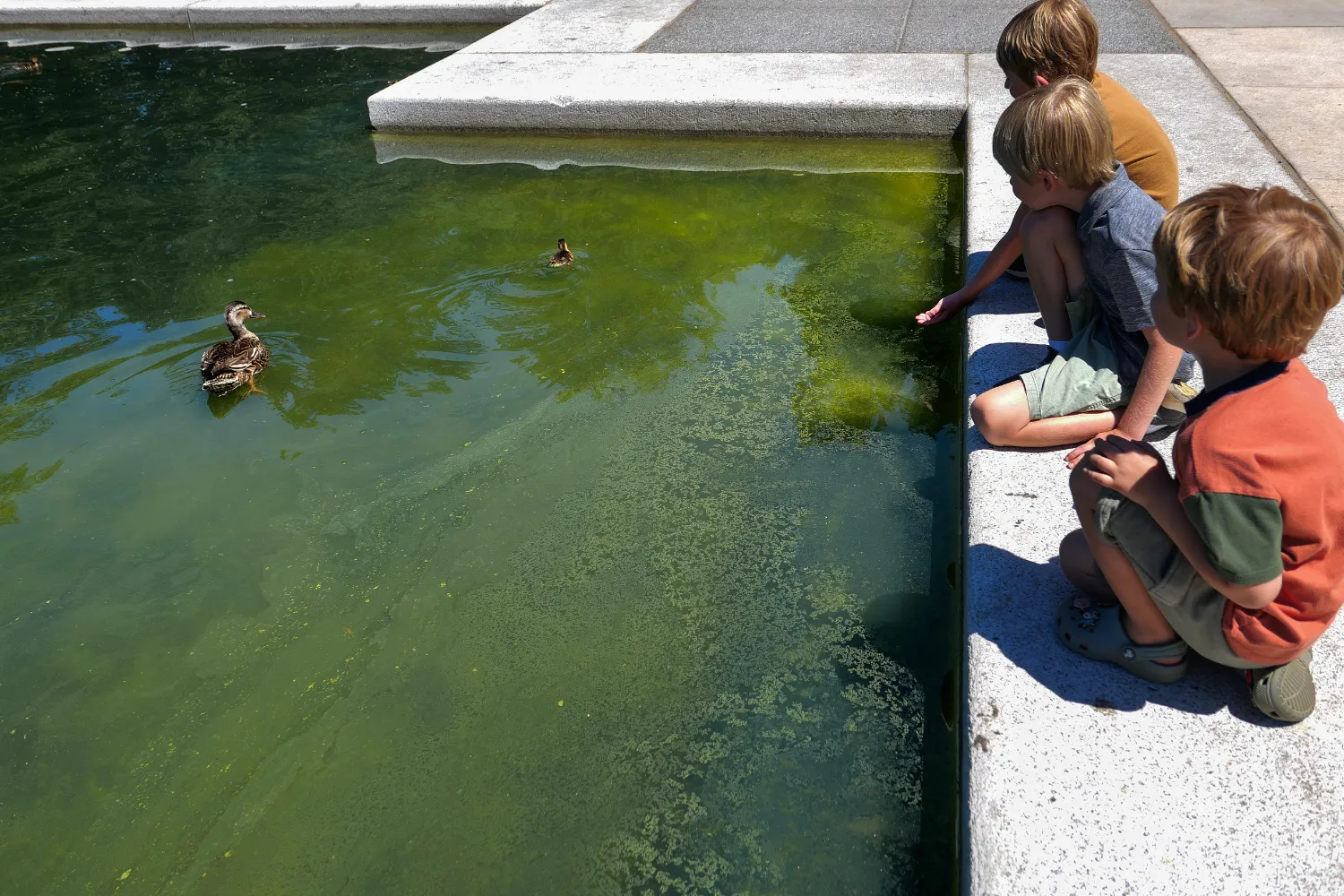
The reflecting pool is not an isolated system. Birds, debris and runoff all interact with the water daily. While the chemicals being added to the water will remove the algae in the pool, because of the ratio used it will not pose a risk to wildlife or humans nearby.
Though the wildlife does play a part in continued algae growth. Lowe noted that even if the pool were sterilized, algae would quickly return.
“Algae will enter through a variety of routes such as being washed in, or come in attached to birds’ legs,” he said.
There are also ecological trade-offs to repeated chemical control. While hydrogen peroxide is generally considered less harmful than chlorine and breaks down into non-toxic components, maintaining the pool through continuous dosing could limit what plants and other matter can survive in the water.
“The hydrogen peroxide should have minimal impact on the wider environment, but his will essentially mean that from the standpoint of nature the pool will be an ecological desert with nothing being able to live in the water,” Lowe said.