 7 hours ago
9
7 hours ago
9
Marcella Patino was hunched over a table at the South Salt Lake Community Center, her pizza getting cold and her nerves fraying. Patino is a single mom with three kids, and kidlike in her own way, tiny and sweet-voiced. When I met her, in the summer of 2024, she was 33 years old and earning $300 a week doing manicures and pedicures. To bump up her income, she had recently gotten a degree from aesthetician school, meaning she could start offering her clients facials and eyebrow lamination too. She would start making $450 a week soon—$23,400 a year, assuming she was able to work year-round with no breaks.
Her rent was $1,550 a month. Then she had to pay for electricity, heat, food, clothing, cell service, health care, child care, gas, and everything else. To keep Patino and her children out of abject poverty, the state of Utah was providing her with Medicaid, SNAP (benefits from the Supplemental Nutrition Assistance Program, better known as food stamps), and $600 a month in cash assistance. “Is it enough?” I asked. She blushed, picking at her nails, hand-painted with miniature strawberries and lemons. She went to food banks, she said. Her mom and her neighbors pitched in. Still, she kept falling into debt.
Whether the help was enough was less of a pressing matter than whether the help would be there at all. A few days earlier, the state of Utah had dropped Patino from its cash-assistance program and SNAP. She didn’t understand why; her caseworker had been no help. That’s why she had come to Circles, a self-empowerment nonprofit that helps its clients boost their income to double the federal poverty line or more.
A Circles volunteer, Stephanie Burdick, hugged Patino and logged on to her account at the Utah Department of Workforce Services (DWS) website, as she had done dozens of times over the prior year. She reviewed the notifications Patino had received, read the emails between her and her caseworker, and looked at her pay stubs. “I can’t figure it out,” Burdick said. It was not the first time the pair had been stumped. Her benefits get “turned off all the time,” Patino told me. Because Utah was asking her to substantiate her poverty all the time.
Generally, Utahns receiving cash assistance or food stamps have to fully reapply for the programs every six months; for Medicaid, every 12 months. But the state was asking Patino for data on a near-weekly basis and requiring her to reenroll in each program every month or two. She did not own a computer and struggled to use the DWS website on her cellphone, meaning she would have to go to the library, attend a Circles meeting, or call Burdick for help. “It takes me hours,” she said. “Sometimes, if I submit an application to one program, it messes up the whole entire other set. Then I have to go back and fix all of it.”
Paperwork abounded, and errors did too. Early in 2024, the salon where Patino had been working closed down. She was unemployed for two weeks before finding another gig. When she filed the requisite forms, Utah logged her as having two jobs at once and removed her from the Medicaid rolls. Patino found out when she was in the ER. Even her caseworker seemed to be struggling to keep up. At one appointment, he admitted that she had lost her cash assistance because “he didn’t put all the paperwork in.”
Her kids vulnerable, her employers exploitative, her bills past due, her gas tank empty, her housing unstable, her benefits unreliable, Patino was emotionally fried. She was startling awake in the middle of the night to check her DWS account. She was afraid to check out at the grocery store, worried that her EBT card would not go through. She was bracing for the gut punch of eviction as she scrubbed the calluses off other women’s feet. And she was spending countless hours dealing with the state—a part-time job, as she described it.
Annie Lowrey: America’s annoyance economy is growing
More Americans are getting signed up for this sort of government work, whether they like it or not. Last year, the One Big Beautiful Bill Act (OBBBA) created a nationwide work requirement for Medicaid and expanded existing work requirements for SNAP. The policies are “not some onerous, burdensome thing,” House Speaker Mike Johnson argued, promising they were designed to weed frauds and cheats out of the safety net.
But the policies are an onerous, burdensome thing—that is exactly what they are. Four million more American adults will have to log their hours to get help with their groceries, along with the 4 million already doing so. As of January, 19 million will have to demonstrate that they are working, in training, or volunteering in exchange for health coverage. Assuming the new paperwork takes the average person two hours a month to complete—a lowball guess—President Trump and congressional Republicans are demanding 552 million hours of work a year from the country’s most vulnerable. The labor would be worth $21 billion at prevailing wages. It would be a full-time job for 265,384 employees.
Plenty of people won’t put in the hours and will lose benefits. Plenty of people won’t do their paperwork correctly and will end up churning on and off of programs, or getting handed additional forms to fill out—like Patino.
As the Circles meeting got going, I asked Patino how many times Utah had dropped her from one program or another. “Oh, I don’t know,” she responded. She huddled with Burdick for a minute or two. “Maybe a hundred times,” Burdick said, matter-of-fact.
“Marcella, you’ve lost your benefits a hundred times?” I responded. She gave me a what-can-you-do shrug and a half smile.
Patino’s situation might be unfortunate, but it is not aberrant or even particularly rare. In my nearly two decades of reporting, I have met homeless people who could not get aid, because they had lost their driver’s license during an encampment sweep. Workers who could not get health coverage, because they were itinerant, constantly crossing state lines. Sick or injured people unable to access disability insurance, because they could not prove they were disabled.
That is what you get when you provide benefits the way the United States does: by discretion, with skepticism, through a perplexing variety of programs with a surfeit of fussy rules. The country does not simply approve benefits for those who qualify. It sets arcane standards, creates arduous enrollment processes, and imposes exacting criteria on desperate individuals. In effect, it charges a fee for access to the safety net, payable in aggravation and frustration and effort and hours. I call it the time tax.
Americans live in the wealthiest and most technologically advanced society the planet has ever known. They supply $8 trillion to the government each year, employing half a million elected officials, 2 million federal bureaucrats, and more than 4 million contractors. And they spend luxury dollars for dive-bar service.
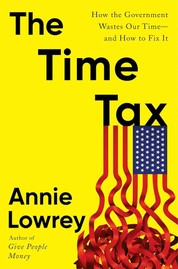 This article has been adapted from Lowrey’s new book.
Estonians are automatically registered to vote and can do so online, a process that takes perhaps two minutes. Americans have to register of their own volition, and many then take time off from work to wait in line to cast their ballots, because elections are held on nonholiday Tuesdays. The majority of Japanese citizens do not have to file an income-tax return, whereas the average American taxpayer spends 12 hours on the 1040 and $290 on private tax-preparation services every year. Residents of Taiwan do not deal with insurer-specific provider networks, open enrollment, or prior authorizations for routine care. Working Americans spend half a billion hours a year on the phone with representatives from their health plan.
Why stop there? More than half of prison admissions for probation violations are due to technical infractions, such as failing to make a court payment on time. Every year, 11,000 Americans die waiting on a disability-insurance determination, and 5 percent of applicants submit more than 1,000 pages of medical paperwork to government bureaucrats. In the early months of the coronavirus pandemic, Wisconsin answered just 0.5 percent of the 41 million calls made to its jobless-insurance program. Half of workers with a flexible spending account (FSA) fail to spend all of the money in it each year, because FSAs are an inane, time-consuming blight. If a worker does not buy enough contact solution by the plan deadline, their employer gets to keep the money left in the account—diverted from the worker’s paychecks.
The American time tax might be ubiquitous, yet it is hardly equally distributed. Noncitizens handle more paperwork than the native-born. People with a criminal record handle more paperwork than those without. The sick face more friction than the well. And poor single mothers such as Patino deal with way more administrative burdens than the pinstriped apparatchiks who passed the OBBBA.
When a person needs help, the first challenge they face lies in figuring out what is out there. Washington sponsors more than 100 anti-poverty programs, nearly all of which are aimed at specific needs and many of which are targeted at specific populations. States, cities, and tribes administer most federal schemes, and offer their own, multiplying the multiplicity. As a result, the Temporary Assistance for Needy Families (TANF), better known as welfare, goes by at least 32 names: Successful Families, in Kansas; Reach Up, in Vermont; the Family Employment Program, in Utah, though Patino called it just “financial.” I asked her whether she meant welfare. “It is financial,” she said, “when you’re looking for better employment, and they help you for a while.”
There’s generally no cross-enrollment among and no common application for these atomized initiatives, because they are managed by different offices at different levels of government, and they have their own rules and standards. SNAP accepts adults whose gross monthly income falls below 130 percent of the federal poverty line, and Medicaid, 138 percent of the federal poverty line. In New York, TANF uses a “standard of need” related to the local cost of living. In Hawaii, the yardstick is 185 percent of the 2006 poverty line. Go ahead and try to calculate that in your head.
Applicants have to prove their eligibility on websites that look like they survived the GeoCities era or on overlong paper forms composed in impenetrable High Bureaucratese. The forms can be intimidating: Many states command qualifiers to read hundreds of boldfaced words on the peril of defrauding the government, for instance. They can be confusing: A state might ask a person to detail how they split the cost of staples such as rice with their roommates. They can be pointedly humiliating: Until recently, Michigan asked unmarried pregnant people what day and where their unborn children were conceived. (Obstetricians don’t ask that!)
If an applicant makes it through this gantlet, maintaining a benefit is often as difficult as procuring it in the first place. Every year, one in five SNAP households and one in 10 Medicaid recipients “churns” off of and on the program. Patino told me that she once lost her welfare benefits because she had missed a shift or two to stay home with her sick kindergartner instead of going out to apply gels. One time, Utah’s DWS sent her an email threatening to cancel her health plan if she did not send in proof that her oldest child was enrolled in school. Participants have no choice but to try to comply with such demands, fearing retaliation for filing complaints.
Burdick wanted to help Patino get back on public assistance, and she wanted to stop DWS from kicking Patino off so often. After the Circles meeting, she went to visit Marsha Judkins, a member of Utah’s House of Representatives, and invited me along. A staunch Republican, Judkins believes in limited government. But she also believes that if a program is enshrined in law and funded with taxpayer dollars, the government should administer it with competent professionalism.
Many of Judkins’s constituents had fallen victim to the state’s incompetence, including members of her own family. Not long before, she told me, her son-in-law had lost his job and tried to enroll in Medicaid. “It was a mess,” Judkins said. “My son-in-law cut his head open and had to go to one of his neighbors, who’s a doctor, to get it stitched up because they did not have insurance.”
Her voice tight with anger, she described calling the state’s Medicaid administrator to sort it out. “I can call,” she said. “I did. And I got it taken care of. Guess what? They’re on Medicaid the next day. Problem solved! But no, the problem is not solved, because I cannot call for every single person.”
After listening to Patino’s story, she decided to help. She tapped out a stern email to the DWS chief: “These delays, mistakes, repeated filling out of forms, wait times, etc. affects the clients’ physical and mental health, which in turn affects their ability to work and function. And how frustrating for DWS workers to not see improved outcomes and success for their clients.”
She asked him for ongoing updates on her fellow Utahn’s case.
For a decade leading up to the passage of OBBBA, Donald Trump vowed not to cut Medicaid. As Congress prepared to pass his bill, he reiterated that promise. Changes would reduce “fraud, waste, and abuse” by stopping services for “people that aren’t supposed to be there, people that are noncitizens.” Yet the OBBBA does not merely cull people who were never supposed to be on public assistance from the rolls. It foists paperwork on older Americans, veterans, homeless people, and former foster youths seeking food stamps. It foists paperwork on nearly every able-bodied, childless, working-age adult in the Medicaid program. Already, more than 3.5 million Americans have lost nutrition support. As many as 10 million people are expected to lose insurance coverage in the coming years.
I went back to Salt Lake City this summer to see Patino and Burdick, and watch the crisis unfold. One in six participants in SNAP had disappeared from the rolls in a matter of months. “Marginal” households with small allotments were dropping out instead of doing the paperwork, Gina Cornia, the director of the nonprofit Utahns Against Hunger, told me. But seniors and young children were going uncovered too, a change she found ominous and could not explain.
At the state’s food pantries, donations were down, and demand was up. The Crossroads Urban Center, a food bank, was “the busiest we’ve ever been,” Bill Tibbitts, its deputy director, told me. “It’s really concerning that we are seeing so many people during a time when the unemployment rate is very low.” Half of the center’s clients were homeless, meaning many of them had just been tasked with filling out a time sheet to keep their EBT card on. A few had asked to comply with the new rules by volunteering at Crossroads after getting something to eat. “If they are showing up as much as they have to for the work requirement, that means they have less time for finding other employment,” Tibbitts said.
State capitols were struggling with the changes too. The OBBBA penalizes states with improper-payment rates above 6 percent, forcing them to cover part of the cost of their SNAP enrollees’ benefits. (The improper-payment rate has nothing to do with fraud and everything to do with programmatic complexity and state capacity. Fussy policies, janky websites, heavy paperwork flows, and unreadable forms create ample chances for enrollees and civil servants to make good-faith errors.) Thus, they are increasing verification checks and upping the number of fraud investigations. Some states won’t be able to lower their improper-payment rate below the threshold, and could end the program instead.
At the same time, short-staffed and tight-budgeted state offices were spending hundreds of millions of dollars to set up the requisite Medicaid systems by January. Utah was doing so while figuring out how to fill a $200 million Medicaid budget gap. “It is a complicated and complex program, and its complexity has expanded,” Tracy Gruber, the state commissioner of health and human services, told Salt Lake City’s Fox 13.
Many Medicaid enrollees don’t even know they’re going to have to comply with a work requirement soon. Adam Cohen is the CEO of Odyssey House, a nonprofit providing care for people with psychiatric conditions and substance-use disorders. Its patients are “not informed about what is going to be cut, and how to keep their benefits, how to exempt themselves,” he told me. What would happen if his clients lost coverage? They were indigent, he said. They would keep living on the streets without treatment. They’d go cold turkey in jail. Some would die.
Odyssey’s clients are among the lowest-income and highest-need in the state. But healthier, better-resourced Utahns are going to struggle with the Medicaid rules too. In 2018, Arkansas briefly imposed a work requirement in its public health-insurance program. Within seven months, one in four enrollees subject to the rules had lost coverage—generally because they didn’t fill out the paperwork. Analysts expect the same to happen with the OBBBA: For every one person who loses coverage because they can’t or won’t work or volunteer 80 hours a month, several others will lose coverage because they can’t prove that they’re working, volunteering, or exempt. And people who can prove it—well, they’ll just be proving it. Work requirements in Medicaid do not change employment rates. They don’t motivate people to work. Nobody expects them to do so now.
All this, for what? I kept thinking as I walked around Salt Lake City last month.
Politicians argue that work requirements and strict enrollment criteria improve programmatic integrity. They stamp out fraud. They discourage welfare dependency. They spur people to get their act together, to work for benefits if they cannot or will not work for a job. Of course, rules and forms and checks can do all of those things. Yet politicians overrate the benefits without even acknowledging the costs imposed on individuals, nonprofits, and the government itself.
I used to think that administrative burdens might be the price we have to pay to have a safety net at all. Americans hold an abiding belief that poverty is a problem for individuals to solve, an ideology developed on prairie homesteads, transatlantic steamships, covered wagons, as well as on sharecropper plantations and in segregated stores. Racial diversity reduces social trust, gins up opposition to redistribution, and heightens concerns about fraud. It generates support for time taxes. Still, Americans did not suddenly fall in love with welfare after President Bill Clinton made the program much more punitive in 1996. I can’t imagine Medicaid and SNAP’s public-approval ratings climbing as a result of the OBBBA. And some new evidence suggests that administrative burdens sour people on the government whether they have to comply with them or not.
Philip K. Howard: Americans are afraid of authority
The surest thing they do is the most obvious thing they do: strip people of time, energy, stamina, self-esteem, and cognitive bandwidth. A few weeks ago, Burdick, Patino, and I met up at a pizza place in Salt Lake City. Patino bounced in wearing a pair of black scrubs, a uniform from the salon where she works. She beamed as she told me about the good changes in her life: her oldest kid enlisting in the Army, going camping with her younger children, dating a great new guy.
“Do you like the job you have now?” I asked. “Are things financially more stable?”
“For sure,” she said. “I’m leveling out. I’m doing my best. I haven’t got one eviction notice this whole year, and so that has been amazing.” The stability seemed to have eased her anxiety and given her space to think long-range. She had come up with an idea for a gel-manicure-curing device. “I went to the University of Utah, because they do help for entrepreneurs,” she said. “I’m going to get it patented, trademarked, and I found somebody who will make it and manufacture it here in the U.S.” In the meantime, she was making extra money training new aestheticians.
How much had Judkins getting involved helped? I asked. Was she finding it easier to deal with the state? The intervention did make a difference, she told me. For a few months, DWS had asked her for fewer documents and lengthened her reenrollment periods. But then everything went back to the way it was. She started having to reapply for her benefits over and over again.
Although she was more financially stable, she was still strained, living in a one-bedroom with her two kids, forgoing meals from time to time. Plus, her income rising had made budgeting harder, in some ways. “I started working at this salon,” she said, gesturing to the black scrubs, “then I started making too much money, and they cut me down on food stamps to $100, and then I had to pay $200 for day care.” She had to make sure she didn’t work too much or else she would lose her insurance.
The next day, the three of us went to a Circles meeting, and Patino explained why she was so afraid of losing her Medicaid. She had torn her ACL, making it hard to do pedicures and leaving her in constant pain. Her new mentor, a volunteer and benefits salesperson named Josh Nelson, talked her through it. “If you are making too much money, it will mess up” your other benefits, he said. “Maybe when you teach a trainee, you can say, Listen, pay me when the student graduates.”
Then he pivoted: Did she have someone to drive her to and from the hospital? (He’d be happy to do it.) Would she have plenty of healthy meals in the freezer? (He and his wife would love to help.) Did she know where she would get the procedure done? (He could research physicians for her.) Like Burdick, Nelson was trying to reduce Patino’s administrative burden. He was also treating her like a human being.
Toward the end of the meeting, Patino told me that soon, she would be not only a client of Circles, but a volunteer. She knew how to deal with the time tax. She wanted to help other moms deal with it too.
This article has been adapted from Annie Lowrey’s new book, The Time Tax: How the Government Wastes Our Time—and How to Fix It.

When you buy a book using a link on this page, we receive a commission. Thank you for supporting The Atlantic.