 1 hour ago
7
1 hour ago
7
MAGA world is angry. Again.
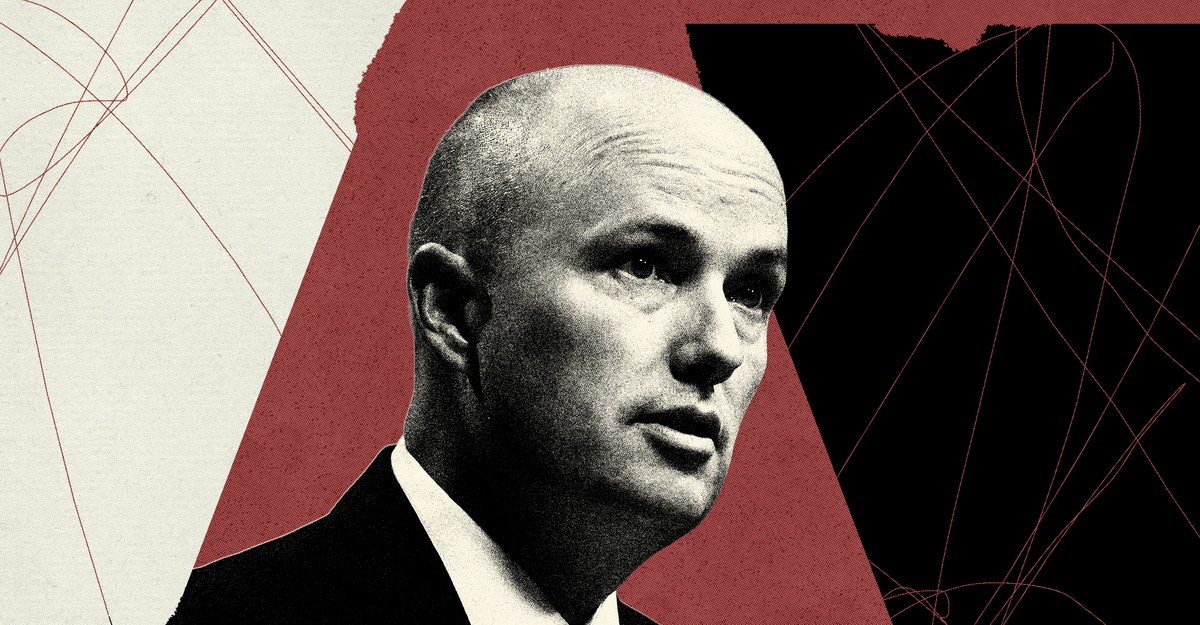
The target this time is Jon Ossoff, the Democratic senator from Georgia. At a reelection rally in Atlanta on August 16, Ossoff was attacking President Trump over the Iran war when he pivoted to a more personal attack on the commander in chief. “The president sleeps through his meetings,” Ossoff said. “He golfs and trades stocks. See, he doesn’t want to do the job. He wants to build his ballroom and travel with Natalie on their apparently defenseless flying palace gifted by the emir of Qatar.”
Those three words—travel with Natalie—sent MAGA world into paroxysms of rage that have yet to subside.
Natalie is a reference to Natalie Harp, the president’s 35-year-old special assistant, who is known as “the human printer” because she accompanies the president carrying a portable printer and battery pack. She uses it to print out hard copies of positive news articles, flattering social-media posts, and polling data to hand-deliver to him on the go.
What Trump’s defenders heard in Ossoff’s line was innuendo. The White House tore into Ossoff. The White House aide Stephen Miller said the senator’s comments are “among the most vile things I’ve seen in American politics.” White House Communications Director Steven Cheung said Ossoff is “a miserable person who hates this country.” He also referred to Ossoff as “Jon Jerkoff” and as “the biggest cuck loser in politics.” The White House spokesperson Davis Ingle referred to him as a “cringeworthy feminine theater kid” and a “lightweight loser.” When the CNN reporter Kristen Holmes asked about Ossoff’s comments, the White House Official Rapid Response X account responded by saying, “Someday, your children will come across your disgusting and inhumane question. They will be sickened and embarrassed to have a parent be so callous and vindictive.” The president, for his part, referred to Ossoff as a “Pee-wee Herman look-alike.” The MAGA ecosystem—podcast hosts, radio-talk-show hosts, political commentators, and others—followed suit. The Rage Machine was in full operation.
What are we to make of the ferocity of the response? The first thing to note is how over-the-top it was, even by MAGA standards. In a pre-Trump world, Ossoff's comments would have been considered edgy. Today they seem almost restrained, even quaint. The president himself, in the early hours of most mornings, posts things about his critics that are meaner and more insulting by orders of magnitude, and no one in his orbit blinks. They tolerate it and, in many cases, delight in it.
The response was also not smart politics. As my colleague Jonathan Lemire wrote, it served only to draw more attention to the story. By elevating the remark, the White House and Trump’s supporters turned a rally line into a week of national coverage, reinforcing the impression of a presidency defined by dysfunction and insularity. Ossoff, an effective Trump critic, got a much larger national audience for free.
So why did MAGA world respond as it did? One explanation is psychological. In 2016, Trump found a constituency already primed for grievance, and taught it to want more. His supporters have kept themselves in a state of frenzy ever since. They need to be perpetually outraged, aggrieved, and insulted. MAGA world has become addicted to the feeling. It delivers a jolt of adrenaline, it provides a feeling of social belonging, and it gives people a sharpened sense of purpose. They see themselves as warriors in a drama of their own construction. They view their opponents—Democrats, progressives, critics of Trump—as personifications of evil. Inflicting pain on their enemies feels good, really good, and it feels just.
Trump is aware of all of this. It’s why, during the 2024 campaign, he spoke directly to his supporters, saying, “I am your warrior. I am your justice. And for those who have been wronged and betrayed: I am your retribution.”
The attacks on Ossoff are also a response to Trump’s collapsing support and the fracturing MAGA movement. Trump’s supporters need to find a common enemy. The Ossoff comments have given them a chance to lash out, to go on the offensive, and to shake feelings of powerlessness and impending doom. At a time when defending Trump is nearly impossible, attacking his opponents becomes imperative.
But there’s something else going on as well, at least with one subgroup of Trump supporters. I have in mind people who are not true believers but who, for a variety of reasons, long ago made their peace with Trump. These are people—many radio and television commentators, podcasters, and members of Congress among them—who were dedicated conservatives before Trump came along. They believed character was destiny and virtue mattered; they revered the rule of law, institutions, and norms; they championed free trade and free markets, fiscal responsibility, and a strong Western alliance; and they opposed patrimonialism, corruption, and lawlessness in the presidency.
They have given up on all of those commitments, and so much more, as the cost of supporting Trump. The cost of speaking out against him, even when they knew better, was simply too high. They wanted to stay in the good graces of those in power. So they broke. And they know they broke.
Read: A stubbornly naive group of GOP senators
This has caused a painful degree of cognitive dissonance within many of them. They want to think better of themselves—and others to think better of them—than their actions warrant. What they see in Ossoff’s comments is a chance to signal that they are still who they once were, or at least seemed to be. In this case, they are portraying themselves as enraged at Ossoff’s “misogynistic lies.” His comments are “repulsive” and “guttersnipe statements.” The senator from Georgia is a “disgusting coward” and a “disgusting pig.” We’re told, “You don’t get lower than that.” They are offended that Ossoff is “punching down” at “defenseless” women.
One can almost hear, from the distant past, their words of moral outrage at Bill Clinton for his affair with Monica Lewinsky. Of course, in this case, Trump supporters have aligned themselves with a man who was found liable for sexually abusing and defaming a woman. Who falsified business records to conceal a sex scandal with a porn star shortly after the birth of his child. Who celebrated his affairs through tabloids. Who said if you have power, you can “grab ’em by the pussy.” Who has called women “fat pigs” and “piggy,” “slobs” and “disgusting animals,” and “horseface.” Who suggested that tough questioning by a woman was due to menstruation. And who has said that “it doesn’t really matter” what the media write “as long as you’ve got a young and beautiful piece of ass.”
But no matter. For these gallant souls, for these defenders of women and their honor, the words that crossed the line of decency were travels with Natalie.
The president’s relationship with Natalie Harp is troubling, but not because there’s any evidence of inappropriate behavior between the 80-year-old Trump and his young aide, a graduate of Liberty University and the product of a deeply conservative evangelical subculture. What there is evidence of is something that, from the perspective of the nation, is quite worrisome: the president’s senescence, and how it manifests itself.
Harp’s path to Trump world began when she said Trump literally saved her life because he approved clinical trials that cured her bone cancer. Experts cast doubt on the story, but it served as her launchpad into Trump world. She is now among his closest aides, almost always by his side.
We know, too, from the letters Harp has sent to Trump that she is obsessed with him. She views him reverentially. According to reports, Harp is with Trump almost around the clock without ever taking a day off. In one letter she wrote, “I want things to always be right between us. I also know I’ve been distracted all week (forgetting to eat throughout the days, and even forgetting to sleep, and only catching a couple hours at a time).”
She has described the president as her “Guardian and Protector in this Life.” She has said to him, “You are all that matters to me” and “I never want to bring you anything but joy.” She has described herself as “unworthy” of him and signed letters to him, “With all my heart, Natalie.” At the close of another letter, she quoted Jane Austen: “I could not have parted with you, to anyone less worthy.”
I have worked in the White House and three administrations. Trust me when I say this is not normal. It’s little wonder that, prior to Trump’s second term, the Secret Service was reportedly alarmed by some of Harp’s letters.
For his part, Trump has become emotionally reliant on her. In Regime Change, the New York Times reporters Maggie Haberman and Jonathan Swan reported that Trump believes she is the only person who loves him as much as his family does. He’s told his staff, “All of you will go off and make money. She’ll never leave me.” In July, when Trump left Turkey on an unmarked plane after reports of an Iranian assassination threat, Trump took only a handful of people on the flight with him. Harp was one of them.
Read: Ossoff’s ‘Natalie’ moment
Their relationship appears enmeshed and pathological. And from this distance, based on what I can piece together, she strikes me as a young person, perhaps wounded by life, and desperately in search of something she thinks she will find in this president. That she won’t will ultimately only make things worse for her. The concern for all of us, though, is what she’s enabling.
Harp is “a one-woman conduit of information operating entirely outside the usual chain of command,” as the Times describes her. The information she passes along to him is unvetted, unfiltered, and highly warped and unreliable. She is a pipeline from the MAGA ecosystem to the president. (She reportedly supplied him with the video he posted depicting the Obamas as apes.) She is further distorting the world for a man who, with every passing year, is detaching more and more from reality. His world is narrowing to a pinhole.
That’s never a good thing, but when it happens to the man heading the most powerful country in history, with the most formidable fighting force ever assembled, it could be catastrophic. Late in the life of Donald Trump, the worst qualities of the man, never a secret, are emerging as never before.
Gabriel García Márquez’s novel The Autumn of the Patriarch is about an unnamed dictator, an illiterate who rises to power and brutally takes control of a country. We’re told about “the perfidy within the presidential palace itself” and of “the greed within the adulation and the wily servility among those who flourished under the umbrella of power.”
The “autumn” in the title refers to the corrupt patriarch’s physical and mental decay, his growing paranoia, his psychological isolation, and his inability to form genuine human connections. He surrounds himself with sycophants, creating a false reality, complete with fake news and newspapers, including a single copy of the national daily newspaper—the news rewritten to please him, created only for the dictator. He needs it to maintain his “throne of illusions.”
Ultimately, we know, thrones of illusion do collapse—and not only in novels.