 1 week ago
24
1 week ago
24
New AI tools are helping financial professionals move through research, analysis, presentations and client work with greater speed. The test is what firms do with that capacity, according to Kevin Buehler, chief innovation officer at Rogo and senior partner emeritus, McKinsey & Company.
Can they use it to cover more clients, analyze more markets and spend more time on judgment-heavy work? Or will AI remain a collection of individual productivity gains, scattered across the organization?
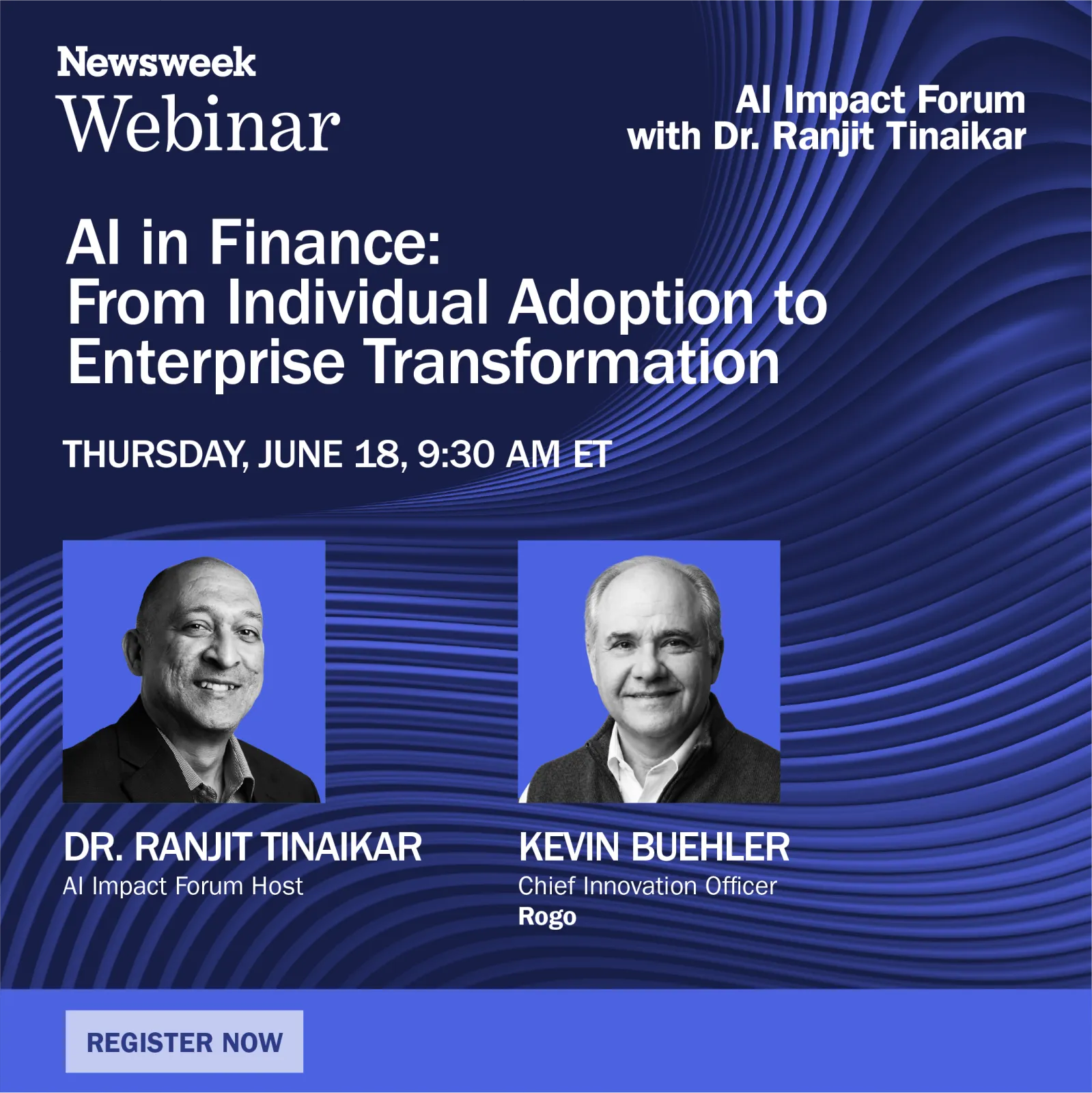
Those questions will sit at the heart of Newsweek’s upcoming “AI Impact Forum” webinar, “AI in Finance: From Individual Adoption to Enterprise Transformation,” scheduled for Thursday, June 18, at 9:30 a.m. Eastern.
In the session, Dr. Ranjit Tinaikar, host of the series, will speak with Buehler about how agentic AI could reshape financial services and what it may mean for analysts, investors, software companies and services firms.
Buehler recently told Newsweek that AI is already having a clear impact among junior professionals—especially in work tied to PowerPoint, Excel, communications and analysis.
“The power of AI tools and the rise of agentic AI is making a huge difference at the coalface,” Buehler said. But individual adoption is only the first layer.
The next stage may come from applying AI across full business processes rather than isolated tasks. Buehler pointed to client onboarding, M&A transactions and lending as examples of complex financial workflows that could eventually be re-engineered with AI.
“How do you use AI to take a process like that and really transform it?” Buehler said. “That’s what I see as the frontier today.”
Jobs will also be part of the conversation, but Buehler does not frame the impact as a straightforward replacement story. The more immediate issue, he said, is how financial institutions choose to redeploy the time and capacity AI creates.
Some may pursue cost savings. Others may use the extra capacity to expand coverage, deepen client work, pursue new business or spend more time training younger employees.
Faster individual work does not automatically become enterprise change. Firms still have to decide how AI fits into the business.
Buehler described three broad stages of adoption. The first is junior-level usage, where analysts, associates and vice presidents use AI to accelerate everyday work. The second is senior adoption, where managing directors and other senior leaders begin using AI more consistently and learn how to manage teams whose work is increasingly AI-assisted.
The third stage is end-to-end workflow redesign.
Most firms, Buehler said, have not yet reached the final stage. Moving further will require an economically driven road map, senior business leadership, better data, talent development and change management.
“They probably need data, and that’s often the Achilles’ heel of these programs,” Buehler said. “They need talent. The talent has to be upskilled and reskilled because you’re not going to just hire new folks to do this.”
The June 18 discussion will also connect adoption inside financial firms to the broader economics of AI in finance.
Tinaikar and Buehler are expected to discuss why human curation and enterprise context still matter, where domain-specific applications may create value and how commercial models may evolve as AI systems begin doing parts of the work rather than simply supporting it.
The competitive line may come down to whether AI remains a personal accelerator or becomes part of how the business runs.
Buehler said many firms are still in “the very early innings” of that process.