
 16 hours ago
16
16 hours ago
16
Elon Musk today became something no human being has ever been before: a dollar trillionaire.
SpaceX priced its initial public offering at $135 per share on Thursday, valuing the rocket, satellite and artificial intelligence company at roughly $1.77 trillion, and when the stock began trading on the Nasdaq today under the ticker SPCX, the largest IPO in history was complete.
Musk, who was worth an estimated $813 billion before the pricing, now commands a fortune of over $1 trillion—built on a SpaceX stake the company's own prospectus valued in the hundreds of billions, plus his long-standing stake in electric automaker Tesla.
The problem with that number is that nobody can actually picture it. It’s almost beyond comprehension, without some kind of comparative anchor. A trillion is a statistical abstraction, the kind of figure that appears in federal budget fights and then slides off the brain.
Just 21 countries produced more than $1 trillion in economic output last year, by the International Monetary Fund's estimates. If Musk counted his fortune in singles, one bill per second without sleeping, he would finish in roughly 31,700 years.
So let's make it physical. Official U.S. currency references give a modern $1 bill as 6.14 inches long by 2.61 inches wide and about 0.0043 inches thick; the Bureau of Engraving and Printing says a note weighs about one gram.
Take one trillion of them—Musk's net worth, in George Washingtons—and measure the pile in four dimensions.
1. Height

Stack the bills in a single tower and it rises 67,866 miles, more than a quarter of the average distance to the Moon.
The International Space Station orbits about 250 miles overhead; Musk's tower of singles blows past it in the first 0.4 percent of its climb.
It clears the GPS constellation at around 12,550 miles, sails through the ring of geostationary satellites at 22,236 miles—the altitude where the world's weather and television satellites live—and keeps going, three times over.
Mount Everest, at 29,032 feet, would need to be stacked on top of itself more than 12,000 times to match it.
2. Weight

At one gram per note, a trillion bills weigh about one million metric tons—about 1.1 million U.S. tons.
That is three Empire State Buildings; the skyscraper itself weighs in at roughly 365,000 tons.
It is the displacement of roughly 10 Nimitz-class aircraft carriers, the U.S. Navy's 100,000-ton floating air bases.
Or, in biological terms, it is the combined weight of roughly 7,000 blue whales, the largest animals ever to exist on Earth.
3. Length
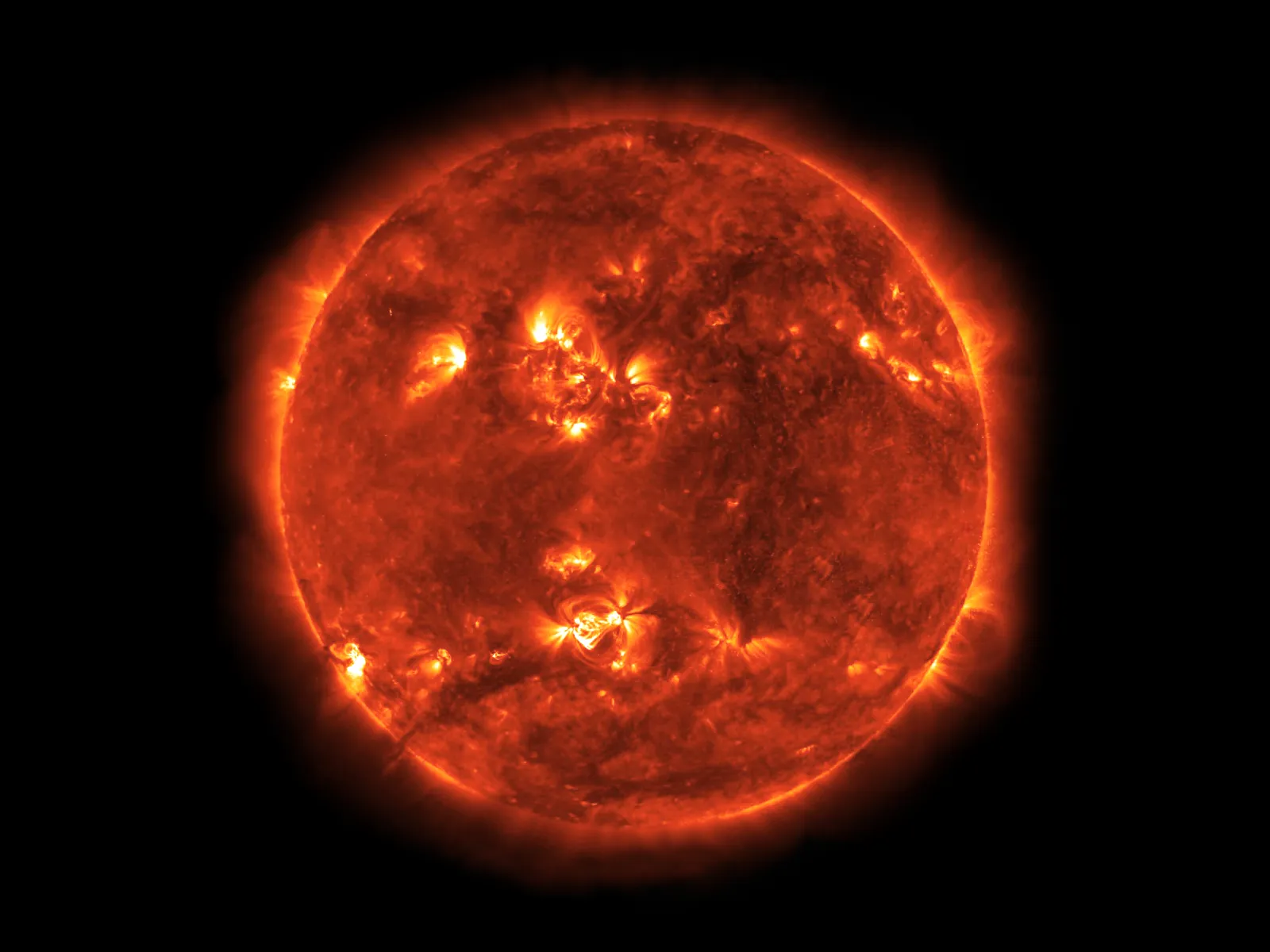
Lay the bills end to end instead and the line runs 96.9 million miles.
The average distance from Earth to the Sun is 93 million miles. Musk's fortune, in singles, reaches the Sun with nearly 4 million miles of cash to spare.
The same ribbon of currency would wrap around Earth's equator almost 3,900 times, or run to the Moon and back more than 200 times.
4. Volume

Compressed into a solid block, the trillion bills occupy about 39.9 million cubic feet.
The Empire State Building encloses about 32.6 million cubic feet, by the building's own published count; Musk's money would fill the entire skyscraper, lobby to spire, and still leave more than 7 million cubic feet of singles stacked on Fifth Avenue.
It would fill more than 450 Olympic-size swimming pools. Or, fill the Lincoln Memorial Reflecting Pool in Washington D.C.—at 2,029 feet long, 167 feet wide, and holding 6.75 million gallons—around 44 times.
Dumped onto a football field, end zones included, it would bury the turf 692 feet deep—a pile of money taller than the Washington Monument.
The Obligatory Caveat
Of course, none of this exists as actual bills.
Musk's trillion is paper wealth, the arithmetic of a share price multiplied across an enormous stake, and it can shrink as fast as it grew.
Much of SpaceX's valuation rests on ambitions, from Mars to artificial intelligence, that have yet to pay for themselves. He could not liquidate it at face value, and no warehouse of singles awaits.
By SpaceX's own reckoning, this is the opening number. The company has tied Musk's new compensation package to two milestones: a $7.5 trillion market capitalization and the settlement of 1 million people on Mars.
If he ever collects, the stack of singles will finally have somewhere to go.
Laid end to end, it already covers roughly two-thirds of the average distance to the red planet.