 2 hours ago
10
2 hours ago
10
The United States and Iran have reached their first breakthrough toward ending their war, with both sides seeking to highlight claimed gains in a costly conflict that has rocked the Middle East and upended global markets.
And while the memorandum of understanding (MoU) announced Sunday and set to be signed on Friday does not yet constitute a lasting peace, the Islamic Republic has come out with the core goal of having survived an unprecedented joint campaign by its two foes, the U.S. and Israel.
Tehran has further succeeded in demonstrating its capacity to exert pressure on international oil and gas trade via the Strait of Hormuz, bringing the fight to Gulf Cooperation Council (GCC) states such as Saudi Arabia and the United Arab Emirates and linking the fate of the Persian Gulf conflict to the parallel confrontation between its Lebanese ally, the Hezbollah movement, and Israel.
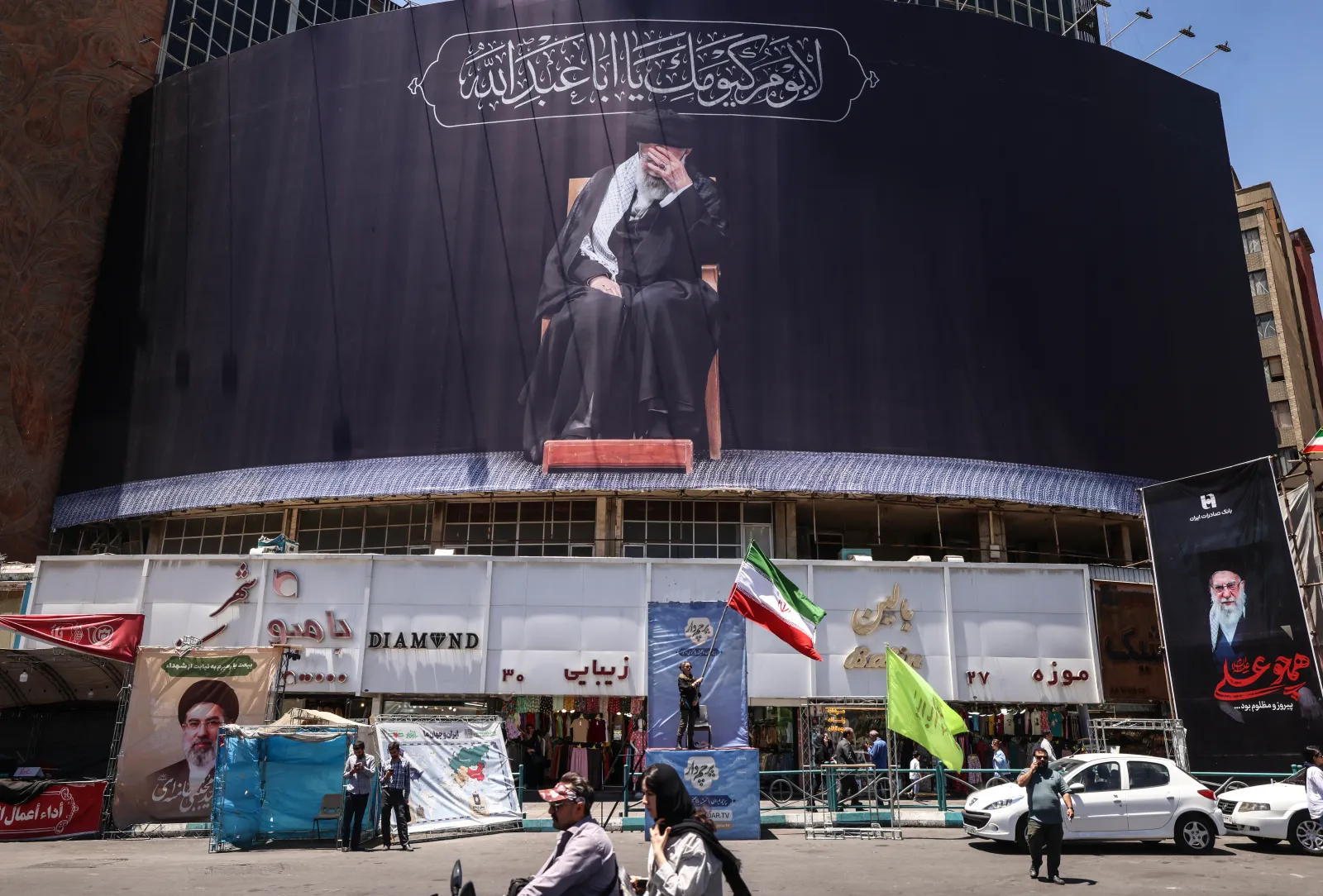
The White House, meanwhile, managed to achieve the elimination of Iran's top leadership, namely Supreme Leader Ayatollah Ali Khamenei, and the destruction of significant portions of Iran's military capabilities.
Yet U.S. President Donald Trump's touted battlefield victory is obscured by anticipations over a more emboldened Iranian outlook under Khamenei's son and successor, Mojtaba.
"Iran has already emerged as a much more powerful country having shown its willingness and ability to directly fight the U.S. and Israel simultaneously—this would mean that Iran will act with more confidence in the region," Sina Azodi, assistant professor at George Washington University's Elliott School of International Affairs, told Newsweek.
The alternative, however, would be "a new normal where U.S. and Iran will clash below the threshold of full-scale war," Azodi argued.
That outcome, while likely to impose further damage to Tehran, would do little to assuage the mounting pressure on Washington over the spiraling impact of the conflict with little guarantee of greater strategic gains.
"I think the primary objective is to end the war and for good and avoid further escalation that is increasingly becoming a norm," Azodi said.
Back to Square One
The contents of the agreement, while still subject to rival interpretations by U.S. and Iranian officials, appear to focus primarily on the immediate conflict at hand, rather than address fundamental issues at the heart of the U.S.-Iran feud. The deal reportedly includes a 60-day ceasefire extension and an end to opposing Iranian and U.S. blockades of the Strait of Hormuz.
What has not been clarified is whether or not the MoU directly addresses Iran's nuclear program or aid to Axis of Resistance allies such as Hezbollah.
U.S. Vice President JD Vance told ABC on Monday that Iranian officials agreed to cut support for non-state partners and that the Trump administration would be "willing to give significant sanctions relief if the Iranians make the kind of long-term commitments that are necessary to be a normal country to give up their nuclear weapons program to stop funding terrorist activities all over the Middle East."
Vance did not provide further details, nor have Iranian officials confirmed any such commitments. He also said no frozen Iranian funds would yet be released as Iranian officials have demanded.
Trump's own announcement on Sunday spoke only of the impact of the deal on the Strait of Hormuz. On Saturday, Trump referred to the arrangement as "A WALL TO NO NUCLEAR WEAPON" for Iran, calling it "the exact opposite" of the 2015 Joint Comprehensive Plan of Action (JCPOA) that he described as "an easy, beautiful, smooth road to a Nuclear Weapon."
Iranian officials have always denied seeking a nuclear weapon, though the nation had substantially increased uranium enrichment levels since Trump withdrew from the JCPOA during his first term in 2018. Amid an attempt to reach a new deal last year, Trump ordered the first-ever U.S. targeting of Iranian nuclear facilities, joining ongoing Israeli operations in what became known as the 12-Day War.
Since the beginning of the U.S.-Israeli war launched against Iran on February 28 this year, Trump has referred to the remnant highly enriched uranium as "nuclear dust" that would be extracted, destroyed or downblended as part of a future deal with Iran.
He told The New York Times on Sunday that Iran would be allowed to enrich uranium at lower levels that “could never be used by the military" as part of a follow-up deal that is expected to begin being negotiated upon the signing of the MoU in Switzerland on Friday.
Iranian officials, including President Masoud Pezeshkian and Deputy Foreign Minister Kazem Gharibabadi, have spoken comparatively little about the details of the MoU, portraying it as a victory in the face of foreign aggression. Pezeshkian hit back at criticism from hard-liner circles on Sunday, emphasizing that the Supreme National Security Council was united in its decision to pursue the "path of dialogue."
Mara Rudman, practitioner senior fellow at the University of Virginia's Miller Center who previously served in White House and State Department positions related to Middle East policy, argued that only the resumption of Strait of Hormuz maritime traffic and progress in negotiations toward the Iranian nuclear issue would constitute "real proof of outcome."
And even if the arrangement does advance into something more substantive, she argued that Washington found itself in a less desirable position than in the past.
"The U.S. has now expended extraordinary military might, and accompanying resources, only to end up poised to negotiate to reduce or eliminate Iran’s nuclear enrichment capabilities for an extended period—a negotiating position in which the U.S. would have had a far stronger vantage point, and three more years to get it done [until 2030], had the president not unilaterally exited the prior agreement in 2018," Rudman told Newsweek.
"And the world knows this, regardless of President Trump’s ability to acknowledge it."
'Mutually Assured Vulnerability'
The U.S. and Iran also have an interest in prioritizing ceasefire extension at the cost of postponing a broader deal.
"The immediate objective for both Washington and Tehran is to stop the bleeding without healing the wound," Ali Vaez, director of the International Crisis Group's Iran Project, told Newsweek. "The U.S. wants Hormuz reopened and Iran wants tangible economic reprieve. The MoU can help them stabilize the situation and buy time."
"Regionally, even a modest deal could calm the Gulf, reopen maritime commerce and create space for a broader security dialogue; failure, by contrast, would likely bring back conflict with fewer guardrails and more appetite for escalation," Vaez said. "What gives this moment momentum is not trust, but fear: all sides have now seen that military force can inflict pain, but not solve the problem."
Masoud Rezaei, senior visiting fellow at the Center for Middle East Strategic Studies in Tehran, described a new kind of doctrine that has come to define the U.S.-Iran dynamic as a result of the war.
"Unlike classical nuclear deterrence—which rests upon the logic of Mutual Assured Destruction (MAD)—this emerging framework may be better understood as one of mutually assured vulnerability," Rezaei told Newsweek.
"The underlying assumption is that Iran’s demonstrated ability to conduct missile and drone strikes against U.S. regional installations and achieve repeated impacts against Israeli military positions, despite the advanced air defense and surveillance capabilities of both countries, has encouraged Washington to shift from a strategy centered on regime change and fragmentation toward negotiation and political agreement."
At the same time, he pointed out that restoring deterrence is crucial for Iran and its Islamic Revolutionary Guard Corps (IRGC), whose asymmetric warfare approach has limits in the face of an escalation cycle dictated by foes with superior firepower.
"From the perspective of the political elite of the Islamic Republic, a fragile peace accompanied by intermittent low-intensity confrontation has been fundamentally disadvantageous to Iran," Rezaei said. "Their assessment is that the IRGC lacks the optimal military capabilities for limited tactical strikes, while the combined defensive architecture of the United States, Israel and their Arab partners can relatively effectively intercept and neutralize attacks conducted at low volume and limited scale."
With skepticism toward U.S. and Israeli commitments rife in Iran, he said the decision to move forward with a deal is primarily a "means of moving beyond the current strategic impasse."
In doing so, Rezaei said, Iran also wields the ability to turn the tables of traditional U.S. economic pressure through its weaponization of the Strait of Hormuz, a measure that looms large over future negotiations.
"Among military and security circles in Tehran, there is a growing belief that in the emerging geopolitical environment, sanctions are no longer viewed as a one-sided instrument," Rezaei said.
"From this perspective, Iran’s capacity to influence maritime transit through the Strait of Hormuz could provide leverage in future negotiations and potentially compel external actors to engage over sanctions relief."