 1 week ago
46
1 week ago
46
Hunter Biden has spent years as a political problem for Democrats—a figure opponents weaponized and allies often tried to keep out of view.
Now, almost overnight, he is something else entirely: a prolific, unfiltered online voice driving millions of views and injecting himself directly into the political conversation.
The shift has been sudden, highly visible, and difficult to ignore.
Biden reemerged on X in late May and early June 2026, posting viral messages targeting critics and President Donald Trump while addressing his own past.
He also appeared in a nearly two-hour podcast interview with conservative commentator Candace Owens, which was released on Thursday, May 21, 2026, just days after his emergence on social media.
It showed Biden stepping out from years of being a political target to present himself directly—candidly discussing his addiction and controversies, while finding unexpected common ground with Owens on media distrust, personal accountability, and even moments of reconciliation across a sharp political divide.
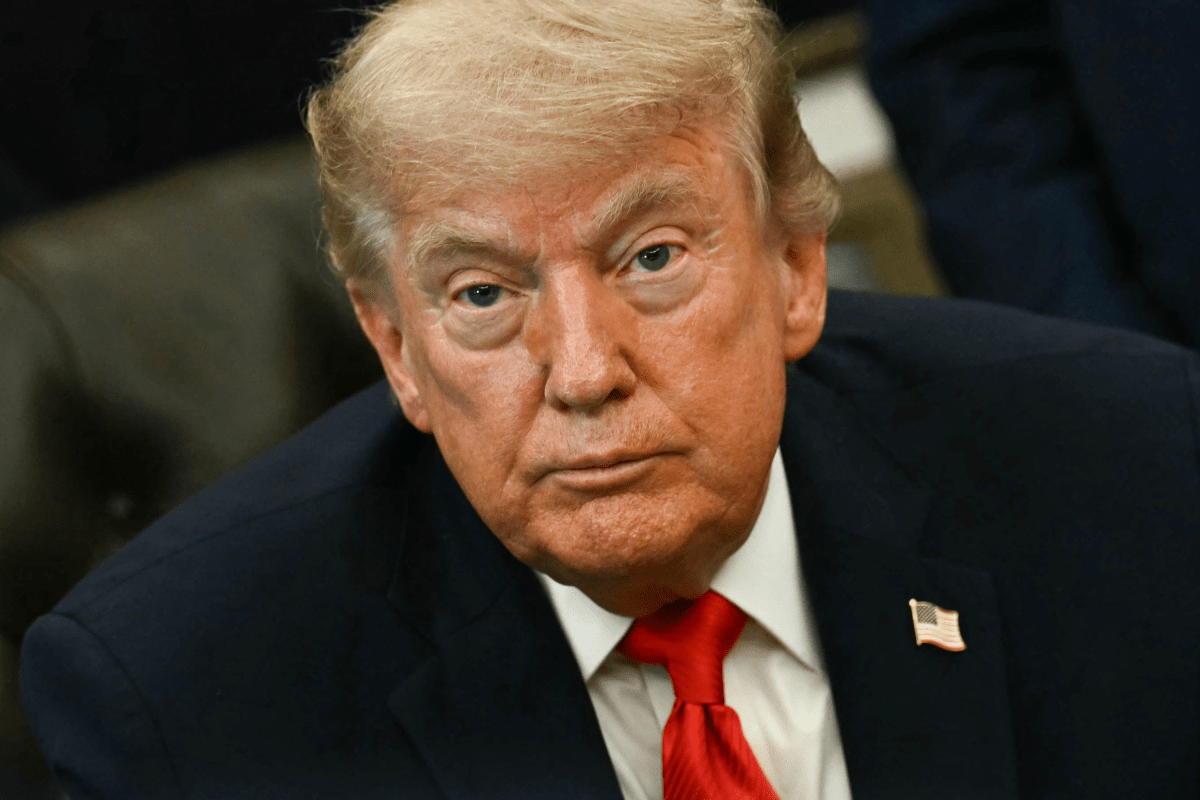
His posts are now generating millions of views and shaping media narratives in real time, with Trump directly asked about a potential 2028 run by Biden during an Oval Office press huddle on June 4.
Political discourse around the Biden family, and coverage of it, is no longer one-directional—Hunter Biden is now an active, unpredictable participant.
Newsweek reached out to Biden and the White House via a direct message sent to his X account and email, respectively, on Friday morning.
Why It Matters
For years, former Democratic President Joe Biden’s wayward son was largely absent as a direct public voice, appearing primarily through legal proceedings, investigations, or secondhand reporting. That absence made him politically potent but personally opaque.
Now, he is speaking for himself—and doing so in a way that is immediate, confrontational, and highly shareable.
A Shift From Silence to Constant Presence
Biden’s return to social media marks a sharp break from how he has previously operated in public life.
On May 19, an X account bearing his name, which has now accumulated more than 420,000 followers, posted a simple message: "I’m Hunter Biden. You’ve never actually heard from me," introducing a direct-to-audience approach after years of limited interviews and tightly controlled appearances.
That post alone, which is now "pinned" to the top of his account, had garnered 10 million views at the time of writing.
Since then, the account has produced a steady stream of posts, combining personal reflection with political attacks and humor.
The tone is often blunt and self-aware, with Biden referencing his past drug use and legal troubles rather than avoiding them.
He marked "7 years sober" in a June 1 post, which quickly became a flashpoint for both support and skepticism online.
When challenged about his past, including the discovery of a small bag of cocaine inside the White House in 2023, he responded with characteristic bluntness. In one widely shared exchange, he wrote: "It most definitely was not. I would never have forgotten my drugs."
The response spread rapidly, becoming one of several posts to generate millions of views and cement his new online persona as unusually candid and combative. Posts like these have reached into the tens of millions of views.
Viral Reach and a New Tone
What distinguishes this moment is not just frequency, but scale. Biden’s posts have consistently drawn large audiences. One message criticizing CNN anchor Jake Tapper attracted more than 4 million views within hours, according to Forbes.
More broadly, his activity has been described as a "social media star" turn, driven by a mix of sharp political attacks, personal disclosures, and dark humor.
In other posts, he has targeted figures within Trump’s orbit, raised questions about media coverage, and engaged directly with individual critics—often in real time.
The style is notable for its immediacy. Rather than issuing statements through intermediaries, Biden is replying directly to users, blending political messaging with internet-native humor in a way rarely seen from figures with his profile.
Direct Confrontation With Trump
The online escalation has increasingly drawn in Trump himself. During a June 4 exchange in the Oval Office, Trump was asked about the possibility—raised partly through online chatter—of Biden entering politics.
Trump responded by referencing Biden’s past, saying it "has something to do with winning an election" and suggesting his record would be a liability.
He added that if other controversial candidates, such as Graham Platner in Maine, could find success, then Biden could as well—comments delivered partly as a joke but quickly amplified online.
Biden responded on X, mocking the idea of a "checkered past" by comparing it to Trump’s own legal and personal controversies. The posts formed part of a broader series in which he has openly attacked Trump and the MAGA movement, while also engaging in meme-driven exchanges.
In another widely viewed post, Biden adopted the tongue-in-cheek label "MAGA whisperer," writing that political divisions were being fueled by elites and calling for "radical honesty."
The exchange illustrates how the dynamic has changed: instead of being discussed, Biden is now directly shaping the conversation.
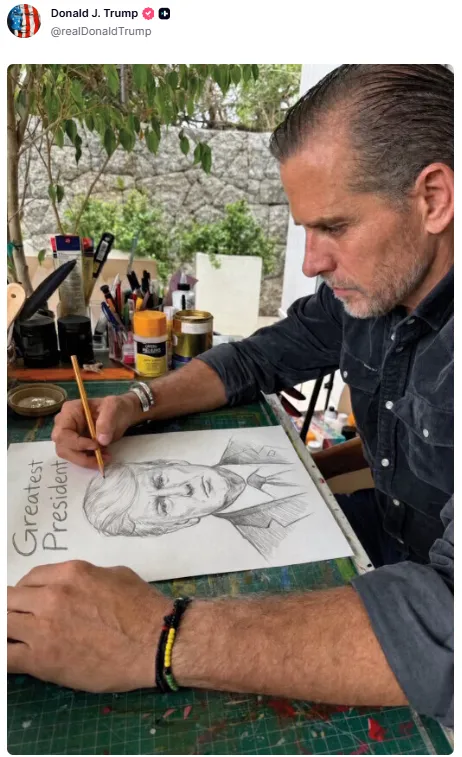
The back-and-forth has increasingly played out across platforms. On June 4, Trump posted an image on Truth Social that appeared to directly mock one of Biden’s earlier posts.
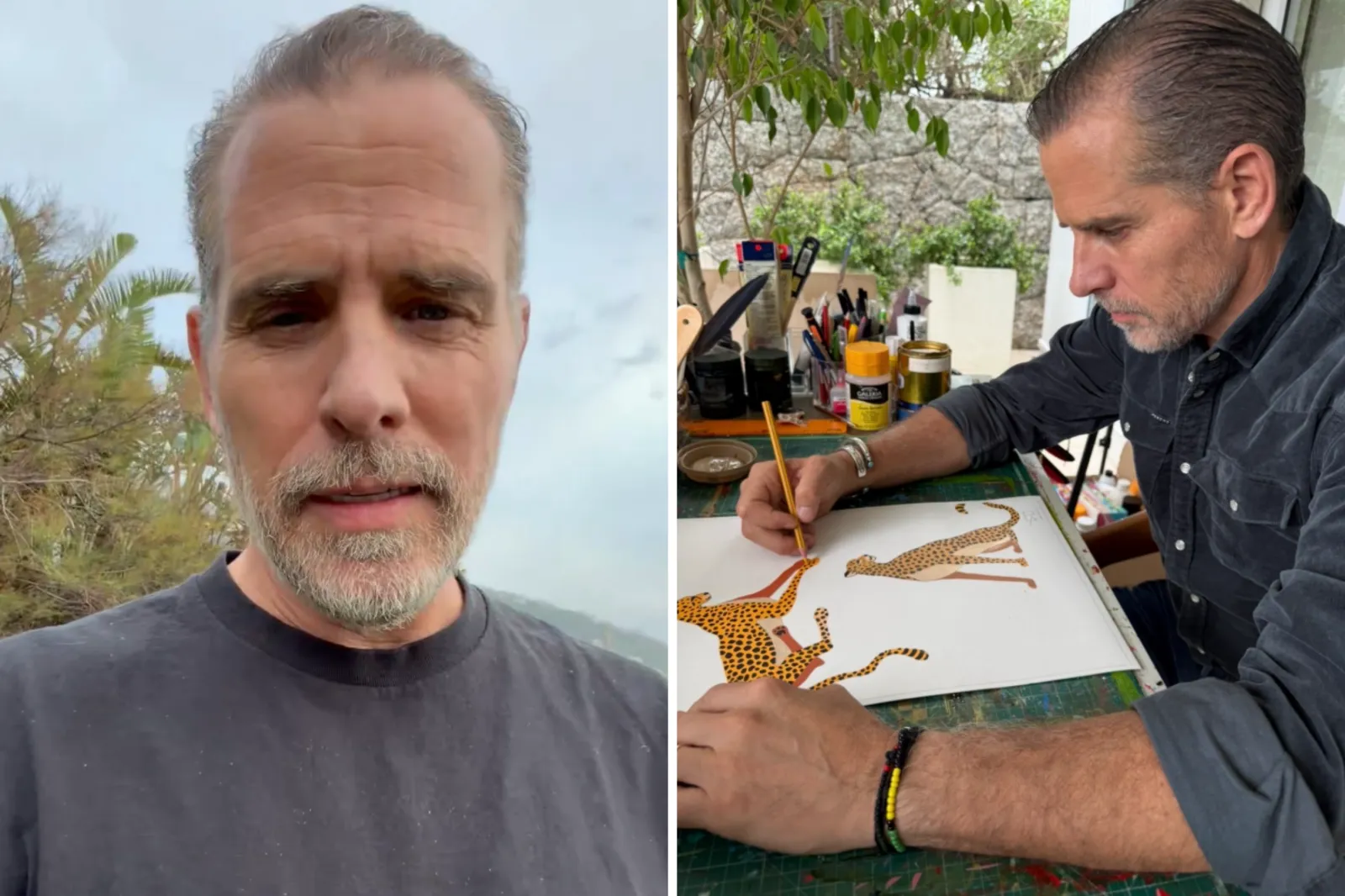
The post reused a photograph Biden had shared in May—showing him sketching at a table—but digitally altered the image so the drawing depicted Trump, alongside the words "Greatest President."
Biden’s original post had been framed around recovery and personal reflection, adding another layer of contrast to how the image was repurposed.
A Personal Narrative Reframed in Public
Alongside political attacks, Biden’s posts often lean into his personal history.
Rather than distancing himself from his past struggles with addiction, he references them directly, sometimes humorously. In one reply to critics, he wrote: "Why does everyone keep saying this? I smoked crack. I would never have wasted cocaine by putting it up my nose."
The approach has drawn mixed reactions. Supporters describe it as disarming and authentic, while critics argue it trivializes serious issues or reinforces existing concerns.
What is clear is that the strategy represents a departure. His personal story—once mediated through books like Beautiful Things and occasional interviews—is now being told in fragments, in real time, to a mass audience.
From Political Liability to Cultural Figure
For much of the past decade, Biden was seen primarily as a vulnerability for Democrats.
His legal troubles, business dealings and struggles with addiction gave political opponents a ready line of attack, making him a recurring presence in partisan messaging.
At times, even allies appeared to favor minimizing his public role.
That context makes the current shift striking. Instead of retreating from scrutiny, Biden is stepping into it—voluntarily, frequently, and with little apparent filtering.
The result is a new role: not a policy actor or campaign figure, but a cultural and media presence capable of generating headlines in his own right.
The scale of attention is measurable. Posts reaching millions of views and driving follow-on coverage suggest an ability to shape media cycles, at least in the short term.
What remains less clear is whether that visibility translates into political impact.
There is, so far, no evidence that his online activity is shifting polling, influencing party strategy, or measurably altering electoral dynamics.
What Happens Next
Biden is no longer just a figure defined by his past or by how others talk about him.
He has become, at least for now, a highly visible and unpredictable presence in the online political ecosystem—one capable of generating viral moments, provoking responses from major figures, and reshaping how his story is told.
What remains unclear is whether that visibility evolves into something more durable—political influence, a defined public role, or simply another fleeting cycle of attention.
For now, the transformation itself—from silence to saturation, from liability to lightning rod—is already reshaping the conversation.